Notes on Calculus III - Vector Basics
Vector
- \(\vec{a}=<a_1,a_2,\ldots,a_n>=\lVert \vec{a} \rVert\cdot\hat{i}\) is a vector in \(\mathbb{R}^n\)
- \(\vec{a}\) has length \(\lVert \vec{a}\rVert=\sqrt{a_1^2+a_2^2+\ldots+a_n^2}\)
- \(\vec{a}\) points in direction of unit vector \(\hat{i}=\frac{\vec{a}}{\lVert \vec{a}\rVert}\), where \(\lVert\hat{i}\rVert=1\)
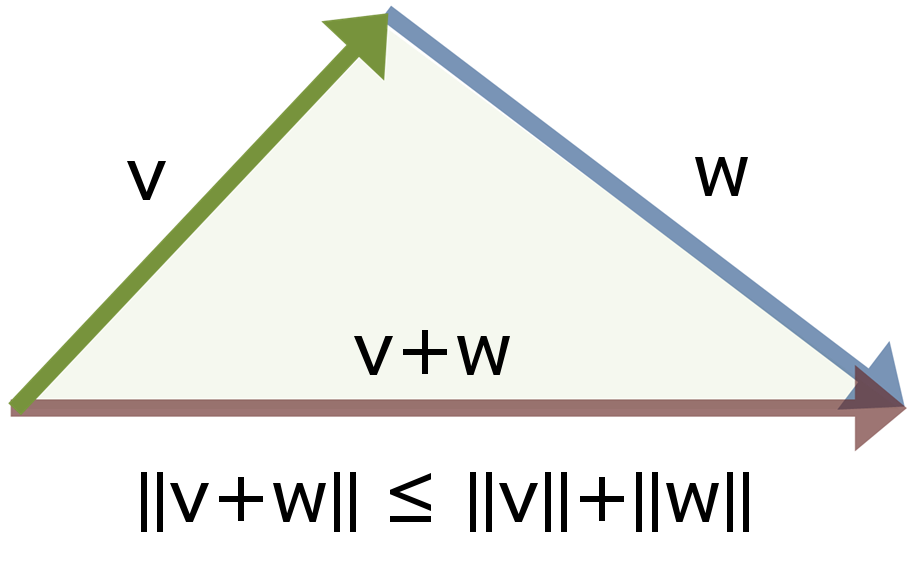
Vector triangle inequality \(\lVert \vec{a}+\vec{b} \rVert \leq \lVert \vec{a} \rVert+\lVert \vec{b} \rVert\)
- Geometric view
-
Algebraic view
\[\begin{align} \lVert \vec{a}+\vec{b} \rVert^2 =&\vec{a}^2+2\left(\vec{a} \cdot \vec{b}\right)+\vec{b}^2\\ \leq&\lVert\vec{a}\rVert^2+2\left(\lVert \vec{a} \rVert\cdot\lVert\vec{b} \rVert\right)+\lVert\vec{b}\rVert^2=\left( \lVert\vec{a}\rVert+\lVert\vec{b}\rVert \right)^2\\ \Rightarrow&\lVert\vec{a}+\vec{b}\rVert \leq \lVert\vec{a}\rVert+\lVert\vec{b}\rVert \end{align}\]
Vector dot product
-
\(\vec{a}\cdot \vec{b}=\sum a_i\cdot b_i=\lVert \vec{a}\rVert \lVert \vec{b}\rVert \cdot \cos{\theta}=scalar\) is dot product of 2 vectors in \(\mathbb{R}^n\), \(\cos{\theta}=\frac{\vec{u}\cdot \hat{i}}{\lVert\vec{u}\rVert \lVert \hat{i}\rVert}\) is direction angle of 2 vectors, \(\mathbf{\vec{a}\cdot \vec{a}=\lVert \vec{a} \rVert^2=\vec{a}^2}\)
-
\(\vec{a}\cdot\vec{b}=\vec{b}\cdot\vec{a}\), \((c\vec{a})\cdot\vec{b}=c(\vec{a}\cdot\vec{b})\), \(\vec{a}\cdot\left(\vec{b}+\vec{c}\right)=\vec{a}\cdot\vec{b}+\vec{a}\cdot\vec{c}\)
-
orthogonal vectors have \(\theta=\frac{\pi}{2},\cos{\theta}=0\Rightarrow \vec{a}\cdot \vec{b}=0\)
-
parallel vectors have \(\theta=0,\cos{\theta}=1\Rightarrow \vec{a}\cdot \vec{b}=\lVert \vec{a}\rVert \lVert \vec{b}\rVert\)
Proof of Cauchy-Schwarz inequality
- Cauchy-Schwarz inequality basic form, \(\left(ac+bd\right)^2\leq \left(a^2+b^2\right)\left(c^2+d^2\right)\)
- Extended Cauchy-Schwarz inequality
Vector projections
-
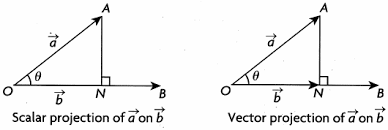
scalar projection of \(\vec{b}\) to \(\vec{a}\) is \(\mathrm{comp}_a b=l=\lVert \vec{b} \rVert\cdot \cos{\theta}=\frac{\vec{a}\cdot \vec{b}}{\lVert \vec{a} \rVert}\)
orthogonal decomposition of \(\vec{b}\) on direction of \(\vec{a}\)
-
vector projection of \(\vec{b}\) to \(\vec{a}\) is \(\mathrm{proj}_a b=l\cdot\hat{i}=\left( \frac{\vec{a}\cdot\vec{b}}{\lVert\vec{a}\rVert} \right)\cdot \frac{\vec{a}}{\lVert \vec{a} \rVert}=\mathrm{comp}_a b\, \cdot \frac{\vec{a}}{\lVert \vec{a} \rVert}\)
vector at direction of \(\vec{a}\) with length \(\mathrm{comp}_a b\)
Vector cross product
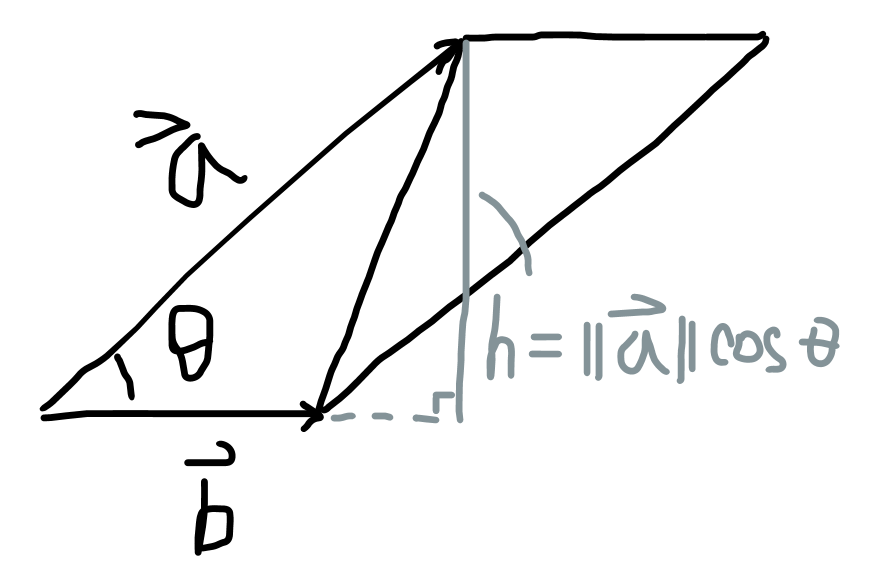
- \(\vec{a}\times\vec{b}=\begin{vmatrix}\hat{i} & \hat{j} & \hat{k}\\ a_1 & a_2 & a_3\\ b_1 & b_2 & b_3\\ \end{vmatrix}=\vec{c}=-\vec{b}\times\vec{a}\) is cross product of 2 vectors in \(\mathbb{R}^3\) or \(\mathbb{R}^7\), \(\vec{c}\) is perpendicular to the plane of \(\vec{a}\) and \(\vec{b}\) and follows right-hand rule, length of vector \(\lVert \vec{c}\rVert=\lVert\vec{a}\times\vec{b}\rVert=\lVert\vec{a}\rVert\lVert\vec{b}\rVert\cdot\sin{\theta}\), \(\mathbf{\vec{a}\times\vec{a}=0}\)
- parallel vectors have \(\theta=0,\sin{\theta}=0\Rightarrow\vec{a}\times\vec{b}=0\)
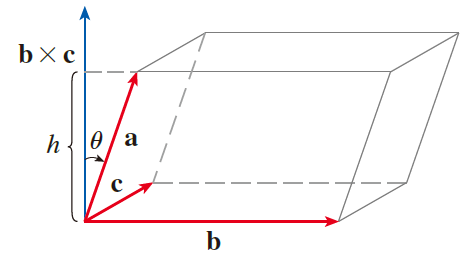
- \(\vec{a}\cdot(\vec{b}\times\vec{c})=\begin{vmatrix} a_1 & a_2 & a_3\\ b_1 & b_2 & b_3\\ c_1 & c_2 & c_3\\ \end{vmatrix}=(\vec{a}\cdot\vec{c})\cdot\vec{b}-(\vec{a}\cdot\vec{b})\cdot\vec{c}\) is triple product of 3 vectors in \(\mathbb{R}^3\) or \(\mathbb{R}^7\)
Areas of triangle and parallelogram
Volume of parallelepiped